Showing posts with label publishing. Show all posts

Tuesday, 13 February 2018

Bringing science into disrepute - Part 2

In December 2017, I received an unusual email from a journal I had never heard of. In this email, I was invited to submit a paper to the International Journal of Agriculture Innovations and Research. It all sounded rather grand, although the email was not signed by a person. No names of anyone in an editorial office appeard in the email, and it felt a little odd. Obviously I have never done any research in this area, and never published in it. So I was a little puzzled about how I got on to their mailing list. But I thought I would set aside my scepticism and submit a paper. After all, what had I got to lose? The time writing the paper, perhaps?

Some years ago, I came across a very funny website called SciGen. Some MIT Information Scientists had got rather fed up with constant invitations to conferences with almost no standards in relation to what they would accept. They developed a site that neeeded only the input of names for authors, and a random text generator would automatically generate a spurious paper in Information Science, instantly. The papers are properly formatted, had references, diagrams, graphs, and enough nonsense jargon to satisfy those who organise academic work only to make money, with no thought given to the quality of science. In fact, the papers are complete nonsense, but they have often been accepted for publication and at conferences. So, it took me about 20 seconds to generate the paper and send it to the International Journal of Agriculture Innovations and Research for their consideration.

Here is their invitation to me:


And here is my response:


As requested, here is my paper.

Best wishes

Will Hughes


I didn't bother with a salutation, or explanation, as no one signed the invitation and there seems to be no named editor. It felt strange writing this kind of covering email for a paper. (Especially in light of the guidance I once wrote about how to write a covering letter for journal submissions.) All this had taken less than a minute. I then waited...

Within 90 minutes, I got this back from them:


Dear Author,
Received your paper and we are submitting it to our reviewers and will get back to you soon.
If you had not submitted .doc (word file) file of your paper, please submit it.
Please also provide the alternate email id and contact number to avoid bounce back problem and communication gap.
Feel free for any query..
With Regards,
Editor-in-Chief,
IJAIR.
ISSN : 2319 – 1473
"Submissions Open"


So, I sent them a Word version, with this email:

Dear Editor

Here it is. I have only one email address. There will be no bounce-back problems.

Best wishes

Will

Then, they must have read it, because two weeks later, at 5 am, they sent this:

Dear Author,
Thanks for your valuable paper submission.
Your submitted paper is not in the scope of IJAIR.
It is most suited to our another journals IJECCE(International Journal of Electronics Communication and Computer Engineering) (www.ijecce.org ). and IJEIR(International Journal of Engineering Innovations and Research)(www.ijeir.org) and we are considering it for IJECCE and for IJEIR.
The review process of your paper has been completed but it will be helpful for us, if you can mail us your concern.


Feel free for any query..
With Regards,
"Wish you Happy Christmas and Prosperous and Bright New Year"
Editor-in-Chief,
IJAIR.
ISSN : 2319 – 1473
"Submissions Open"

So I came back with:


Hi
Thank you for this. I have no concern. Please go ahead.
Best wishes
Will


And, hey presto, my paper was now submitted to two more fake journals:

Dear Author,
Thanks for updates and soon you will get the final response from IJECCE and IJEIR

Feel free for any query..
With Regards,
"Wish you Happy Christmas and Prosperous and Bright New Year"
Editor-in-Chief,

IJAIR.
ISSN : 2319 – 1473
"Submissions Open"


I noted that there was still not editors named and nothing that would lead me to believe that this was real, but we we all seemed happy enough, spinning each other along.

The very next day, I got an email with seven attachments! The paper had been reviewed and the referees' comments were in. Fantasic! I was looking forward to read about how the paper was utter nonsense and could not possibly be published. It was going to be a great rejection letter, I was sure. Imagine my surpise when I read this:


And, 40 minutes later, this:


The same paper accepted in two different journals! This was despite their insistance that no paper can be considered for publication if it is being considered for publication elsewhere. They had messed that up, big-time. Still, I was looking forward to the referee reports. Given that the paper was pure random mush, they must have pretty steep requirements? Here are the referee reports, 1 and 2.

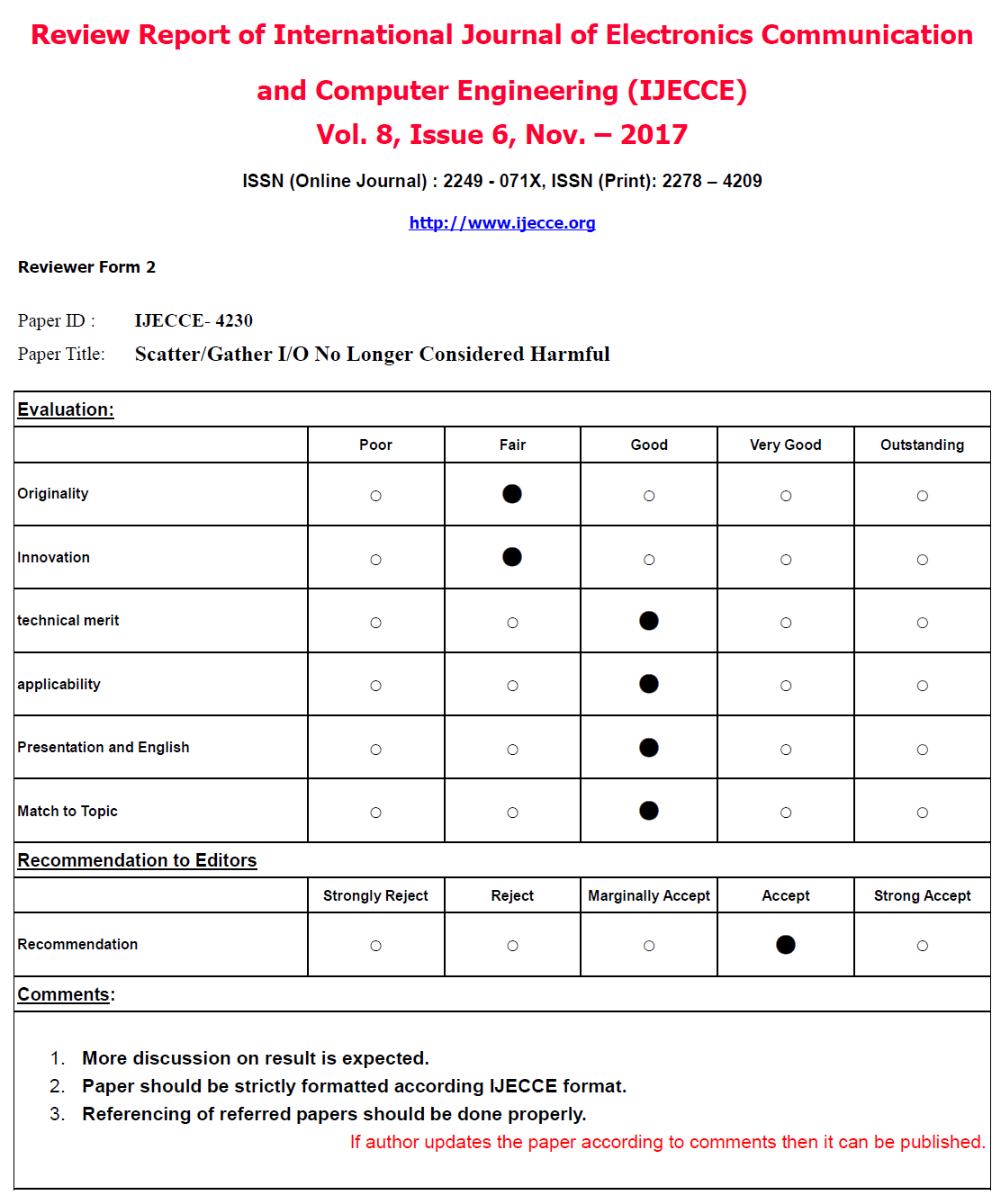


This was getting rather stupid. Both journals sent exactly the same referee reports. They were behaving like money-grubbing idiots, so I felt that this was the time to close this down. Here was my final message to both journals:

I am not paying money to publish a paper in your journal. You should have mentioned that there was a fee before you embarked on this process. By the way, I don’t know who you asked to review this paper, but they have no expertise in this area. They have utterly misjudged this paper. Your editor-in-chief is also ignorant in relation to the topic of your journal. I have no idea why you think I would pay money to publish in such a terrible journal. What are you playing at?

You do not even sign your emails with a name. This is not an academic process in any way. If you want to publish this paper in your so-called journal, go ahead. But I am not paying a penny. And I don’t care whether the paper cannot be withdrawn. Keep it. It can bring you nothing but disrepute.


They never answered this, and I suppose they never published the papers. Now the agriculture journal have written asking for another paper. I am not sure I can be bothered again. It took much longer to write this blog post than I spent on the actual tasks. But then, that's the price of having a blog!


Thursday, 26 October 2017

Bringing science into disrepute

There is a growing number of journals and conferences whose sole purpose seems to be to elicit papers and then charge authors for publication. This is not the route to scientific communication and dialogue. Here is today's example, which seems to be sent to anyone they can get an email address for, regardless of the kind of science or quality of work:

Journal of Applied Science and Innovations

Dear Dr Professor Will Hughes

Greetings from Journal of Journal of Applied Science and Innovations 

To celebrate the Vol. 1 Issue 3, it is our pleasure to invite you to contribute an article. Your contribution will help the journal to establish its high standards and get indexed by prestigious indexing services soon.

Short-communications, Review articles, Research articles, Case reports etc. are also accepted.

Note: On this happy occasion, we are here to announce that those who contribute their manuscripts will receive Discount to the articles submitted on or before November 10, 2017.

Submit your article at to this E-mail id.
appliedscience@rroij.com, editor.jasi@peerreviewedjournals.com

Please provide your acceptance to the same.

Look forward for your reply

Best regards,
Cynthia Grace
Journal Coordinator 
Journal of Applied Science and Innovations

Disclaimer
This message is confidential. It may also be privileged or otherwise protected by work product immunity or other legal rules. This email and any files transmitted with it are confidential and intended solely for the use of the individual or entity to which they are addressed. If you have received it by mistake, please let us know by e-mail reply and delete it from your system; you may not copy this message or disclose its contents to anyone. The views, opinions, conclusions and other information’s expressed in this electronic mail are not given or endorsed by the company unless otherwise indicated by an authorized representative independent of this message.

There are hallmarks of fake standing here. Claims that the journal has high standards and hints that it might become indexed by as commercial indexing service, as if that were a badge of recognition. It isn't. Many indexing services are indiscriminate. The list of types of communication that indicates they will take anything as long as you pay. You can even get a discount on the charges for publication if you are quick! So, the only things missing from this is any connection to a recognised University, an established publisher, an international editorial board, a web page, even a named editor who is an authority in a particular field.

I sincerely hope that no one is taken in by this cynical practice of milking the academic community for money.

Sunday, 5 June 2011

What editors look for in referee reports

A recent discussion in orgtheory.net sparked some interest. I was particularly interested in the views from editors of various journals such as Organization Science, Organization Studies, Academy of Management Journal, Management Science, American Sociological Review, and Administrative Science Quarterly.

If you are interested in improving the way that you carry out reviews, there is some excellent guidance there. I added a note, as follows:

This discussion provides an excellent presentation of the diverse and multiple aspects of a good review. In Construction Management and Economics, we have also been dealing with how best to advise referees. One thing of vital importance, as mentioned by several of the editors, is to ensure that the referees deal with the content rather than the presentation/style of the paper. To help focus attention on what matters, I have recently developed a more explicit description of what I mean when I say “scientific content” because in an applied and practical field like construction management, it can be difficult for some people to distinguish research from practice, let alone content from style.

I am increasingly asking referees to consider this definition of the scientific approach when the write their reviews: “The observation of certain specific phenomena within a theoretical framework in order to develop better explanations that improve our collective understanding.”

Specifically, I want to avoid papers that merely report on specific phenomena. I want referees to tell me whether the papers they review are explicit about the extent to which a paper deals with the phenomena being observed, the underlying concepts and theoretical framework being used, the existing explanations being critiqued or found wanting, and the new explanations being proffered that add to our pool of knowledge. And all of this has to be done within the conventions of what a paper in this field looks like.

This is a complicated and difficult issue, and the way we put our requests to referees is constantly developing. What makes a paper acceptable is conformance with the customs and practice of the particular field in terms of: how arguments are presented, how data is used,how research is carried out, formatting of papers. The overriding criterion is clarity. These are the issues that I wish referees to guide me on when I am deciding the fate of a paper.

Crucially, reviewing a paper for a journal is clearly not the same thing as writing a critique for a literature review.

Tuesday, 3 May 2011

Unsanctioned authorship

I just sent this email to a scientific editors' email forum. If you are interested in commenting, please add your comments to this blog, and I can include them in a summary of the discussion:

I am interested in the phenomenon of authors adding co-authors to their papers, without first consulting the so-called co-authors. I get the feeling that this is something that is rare, but gradually increasing. I think that people might do it to make their papers look more authoritative, or to drive up citations by adding a highly-cited author. Clearly, it is bad practice and I was wondering what could be done to ensure that it does not happen.

My impression from the publishers is that their aim is to ensure that if it does happen, they are not culpable. They will have had the corresponding author sign a declaration that all of the authors are aware of the paper and are validly listed as co-authors. Yet this does not overcome the problem, it merely moves the liability for the problem, in my own view.

Is this something we should be worried about? Should we seek explicit acknowledgement from each author that they have indeed played an instrumental role in the production of the paper? Or is it sufficient to identify this as the sole responsibility of the corresponding author? I would very much like to hear your thoughts on this issue.

Friday, 11 February 2011

Nominating referees

An author asked me if I coud suggest names of referees for him to nominate in the process of submitting a paper to Construction Management and Economics. I replied to him, no need. If I can nominate them I can select them when I am selecting reviewers! The reason for asking authors to nominate is two-fold. First, we may be lucky and get introduced to someone we had not previously come across. Second, it helps to understand better what kind of academic is best for the paper. It is more informative than mere keywords, which are bit uncertain. I don’t want authors to think that we actually use the referees they nominate when we choose reviewers for the paper. It just helps us to think about the kind of person they have directed their paper at. We would use the people they nominate for other papers in the same area. After all, this is a double-blind review process! It is interesting how these processes are interpreted in different ways.

Wednesday, 26 January 2011

Academics vs practitioners?

In discussing the opportunities for involving practitioners as authors in Construction Management and Economic a friend of mine challenged me because he got the impression that I was wanting to work in isolation from industry in case "they contaminated our minds and data"! I felt that he was misunderstanding my motives. Of course it would be disastrous if academics worked in isolation, I agree 100%. Our research is rightly grounded in the construction sector. It certainly is not the case that I think that practitioners contaminate our minds and data. I agreed 100%. "They" ARE our data! They are the source of the problems that we study, they may sometimes be the source of solutions that we seek to understand and, frequently, they are the very people that we study. No, there is no sense of isolation there.

My point was that our data subjects are not authors. It was to do with ensuring that our message is tailored to suit our audience. If the findings of our research are meaningful for industry, then we must, of course, present them to industry. But in the journal, we are academics talking to academics, in a fairly structured way guided by conventions that may not be appropriate for a wider audience. In the journal, we are focusing on theory-testing and/or theory-building, but not on the dissemination of our results to a wider audience. That is the crucial characteristic of an archival research journal like ours - to record advances in research. Other media already exist for recording and disseminating advances in practice. I think that is right, and it is helpful for everyone to have this distinction.

So, yes, it is precisely because practitioners define our field by their practices that I am interested in their contributions. But not because of their ability to carry out research projects with us. Of course, there are people who have a foot in both camps and I do come across practitioners who have done "proper" research that is reportable in our pages. But then they are generally writing as researchers, not as practitioners. So the boundary is blurred. The acid test for a research paper is simply this question: does it test or develop theory? If the answer is "yes", then we are interested. If it is "no", then we are not.

And, I also acknowledge that although this is the editorial policy now, it may not be the editorial policy forever, and it was not the policy many years ago. Everything is open to challenge and change!

Friday, 14 January 2011

Comparing the values of research outputs

Recently, the CNBR network carried a message announcing a conference in Australia, and one of the recipients sent a rejoinder about how this particular conference was one that was selected as an "A" rated conference for the Australian Excellence in Research for Australia (ERA) scheme. This scheme involved ranking all journals and conferences and giving them a rating. It provides an administrative route for Australians to decide whether to appoint/promote academics, based on how many research outputs they have got in the top-rated outlets on the list. It also means that Australian universities would probably not fund their staff to go to conferences that are not A-rated. This is symptomatic of a much wider movement in society, generally, to avoid the need for professional judgement at all levels. Some commentators (e.g. O’Neill, O. A Question of Trust: The BBC Reith Lectures 2002. Cambridge: Cambridge University Press.) have connected this to the decline of trust in society. Of course, although there is a general feeling that trust is in decline, and that we need more of it, it does not necessarily follow that we do indeed need more trust. It is interesting to read Cook, Hardin and Levi (2007) (Cooperation Without Trust?) who argue that there are better things than trust to account for social order.

When I was working on the Professional Futures study, it was clear that there was a growing difficulty in society in terms of making judgements. I think this is getting worse. People are so frightened of making judgements of any kind that they would prefer to have objective lists of publications, rather than actually look at things and figure out whether they are any good. This prompted me to respond to the list as follows:

I think it flags up the lunacy of the whole process of ranking conferences and journals in this way. Are we to suppose that just because a paper has been published in an A*-rated journal or A-rated conference that it is definitely better than a paper in a B-rated forum? And are we to suppose that anything that was published outside of these A-list things is somehow sub-standard?

I sincerely hope that most of us are clever enough not to accept administrative views of what constitutes quality when it comes to research outputs! I would hope that academics have an eye on their peer groups, and on their own careers beyond their current employer, even if we are told where to publish. What senses do we lack that we cannot detect good conferences, journals and papers for ourselves?

Various colleagues responded privately to me, agreeing and offering observations about how the list was compiled in a very narrow and parochial way. One colleague from the Netherlands observed that although she agreed wholeheartedly with my views, if you find yourself in this situation, there is no much that you can do. And my rejoinder was:

It places you in a difficult position, for sure. If it is not your peers who are deciding which are your most important outputs, what chance have you got?

I think that in such a situation, it may be helpful to acknowledge that there are two different games to be played, and they are somewhat incompatible, but not wholly. First, our bosses want us to perform in a strictly quantifiable way that requires numbers of papers in certain places. Second, we need for our own careers to figure out a publication strategy that places our work where it reaches the peer group we seek to access. Admittedly, these two activities overlap, hopefully by a lot. But we have to acknowledge that sometimes it is necessary to publish outside the manufactured lists. In the long run, it is important that academics keep an independent sense of what their field looks like. Also, I would expect that this whole discussion may look different in other fields.

So, I agree that it is not possible to ignore the lists when you are subjected to that kind of regime. But I also think that we have to keep a sense of perspective, and ensure that our publications help each of us to develop an appropriate publication profile that can be appreciated by our peers not just for quantity, but for quality of the research. And that requires subjective, professional judgement.

It is worrying when intelligent people like academics collude in the erosion of their own judgement.

Thursday, 23 September 2010

Multilingual editorial guidelines for scientists and translators (Press release)

The European Association of Science Editors (EASE) has recently published simple editorial guidelines for authors and translators of scientific articles (http://www.ease.org.uk/guidelines/index.shtml).This project is aimed to make international scientific communication more efficient and to prevent scientific misconduct. The guidelines advise on how to write complete, concise and clear (=understandable) manuscripts, and explain what is regarded as scientific misconduct. If authors and translators follow the guidelines before submission, then their manuscripts will be more likely to be accepted for publication. The editorial process will probably also tend to be faster, so authors, translators, reviewers and editors will then save time. The guidelines also explain what is regarded as scientific misconduct and provide links to the flowcharts of the Committee on Publication Ethics (COPE).

The document is freely available as downloadable PDFs in English, French, Spanish, Chinese, Japanese, Korean, and we plan to add more translations (made by volunteers) in the near future. Moreover, the English version has appeared also in print, for distribution during some major scientific events, such as ESOF2010 in Turin and the AIDS Conference in Vienna. EASE nominated the guidelines for the ALPSP Award for Publishing Innovation 2010. Our association did not receive this award, but the ALPSP judges stated that the guidelines “meet a very real need and very much hope that EASE will be able to secure sufficient endorsement from editors for the guidelines to become a recognised standard.”

Sunday, 20 June 2010

Double-blind reviewing

As previously noted in this blog, the practice of double-blind refereeing is often compromised by authors who cite their own previous work in their draft papers submitted for review.

It is in the author's interest to maintain their anonymity, and the main reason for doing this is to protect unknown authors from being dismissed out of hand. It is easy enough for an author to cite his or her own work as "Anonymous, Year" and to enter "Reference omitted for purposes of refereeing, to be inserted in the event of acceptance", or similar, in the list of references. If authors choose deliberately to reveal their identity, there are many other ways that they can do this, so we do not expend a lot of editorial time on trying to overcome this. It is rarely such an obvious method of revealing an author's identity that surely it cannot be accidental?

Friday, 23 October 2009

To withdraw or not to withdraw?

A colleague from another University asked me a question: he submitted a paper to an international journal and had received no response after 10 months. He tried to contact the editor and his secretary said that the review process has started but they have not received all the responses from reviewers. Did I think it is OK for him to write a formal letter to withdraw the paper now? Or should he wait until the decision is made, no matter how long it takes? I was quick to advise him as follows.

In my experience, the gathering of referee reports is a burdensome task for an editor and the editorial office. One of the reasons that it can take so many months to get reports is that referees often do not answer promptly, or they say they will carry out the task, then change their minds, or they are just slow because of all the other demands on their time. Often, over a period of many months, we might find that we have tried 20 different referees in order to end up with the requisite four reports.

After all this work it is very annoying to then discover that the author wants to withdraw the paper! However, if the paper is rejected, then there is no real problem. Alternatively, if the decision is Major, or Reject & Resubmit, then that is an opportunity for the author to say to the editor that the requirements are just too harsh, and that he or she would prefer to withdraw it. But if an editor calls for minor revisions, or simply accepts the paper, the author really should not withdraw it. It would be bad protocol, because the editorial office and the referees wouyld have been working through this process for no reason. Perhaps the question to ask is, why would an author want to withdraw a paper mid-way through a long refereeing process? I have come across situations where an author has realized, too late, that there are such significant flaws in the paper that it really should go no further. This would need some careful dialogue wit the editor, explaining why the paper cannot continue in the process.

I summed up my advice thus. Therefore, you need pretty strong reasons for withdrawal. Either the editor's requirements are too harsh, or you have discovered some aspect of the paper that renders it unpublishable. I don't think that you should withdraw for any other reason, unless you want to upset the editor!

Wednesday, 7 October 2009

ARCOM Proceedings

I suddenly remembered that I had not yet finished with ARCOM 2009! Each paper will now be made into an individual PDF and uploaded to the ARCOM website from where it can be downloaded free of charge. What a great service! It is a laborious task, though, and I am really pleased to have enlisted the help of my newest PhD student, Hafizah Mohd Latif, who is sufficiently knowledgable about computers to add her strength to mine. Now the task will be completed much sooner than I could do it myself. The only thing that remains then will be to update the database so that these files can be discovered by searching in the abstracts database. It should not take too long to get all this sorted out for another year.

If you want to see previous year's papers, go to www.arcom.ac.uk, click on "Abstracts", click on the link to the search page, click on Browse, then click on "ARCOM Annual Conferences", then choose a year, and you can browse all the papers, downloading any that you want to read.

Friday, 24 July 2009

Authorship of journal papers

The Co-operative Network of Building Researchers list, cnbr-l, saw a fresh enquiry today about authorship of journal papers. I was interested that the person who prompted the enquiry appears to be a rock climber. The essence of this question was this, I’d like to invite discussion of the (possibly contentious) issue of authorship of (journal) papers in construction management – particularly who is named as authors, and in what order, when PhD candidates or other new scholars write papers. This is an issue on which I have strong views, so I responded thus:

You raise a useful and interesting question. My own view is that authorship should not be simply a right of those in authority to have their name on things whether they contributed to them or not. For what it is worth, here is how I put it in a chapter of a recent book:

One worrying aspect of authorship is the question of whether all the authors actually contributed to the writing of the text in the paper. There are different traditions in different areas of science. For example, in some sciences, the head of the institution, the head of the research team, the technicians who provided the resources to enable the research are all cited as joint authors, even though they may have contributed none of the text. In other areas, only those who directly contributed text would be listed as authors. The latter tends to be the case in construction management, although there are some notable exceptions. Because we operate with different assumptions, there is confusion around this issue, and all authors should clarify who will be listed, and in what sequence, before they begin work on their papers, to avoid divisive and difficult arguments later in the process. One alternative to joint authorship, for someone who is not actually an author, is to include mention of them in the acknowledgements (Hughes, W.P. (2008) Getting your research published in refereed journals. In: Knight, A. and Ruddock, L (eds). Advanced Research Methods in the Built Environment, London: Wiley-Blackwell, 193-206)

To answer your questions directly, my opinion is that PhD students should be encouraged to write sole author papers, and it is the responsibility of the supervisor to help structure the paper, comment on drafts, and help see it through the publication process, in the role of supervisor, not in the role of co-author. But I know that this is not everyone’s preference. If a supervisor actually writes part of the paper, then of course that would justify co-authorship. However, in any serious evaluation of one person’s contribution to the field, such as a promotion panel, it is common to ask the candidate to indicate what percentage of each co-authored paper was contributed specifically by the candidate. This avoids any need to develop an algorithm for assessing the strength of authorship when there are multiple authors (as suggested by another respondent to your question).

This question is not a “construction management” issue, but an issue across all the sciences. You might be interested in a broader discussion here: http://www.councilscienceeditors.org/services/authorship.cfm where I particularly liked the opening sentence, “Studies of authorship in science suggest that traditional criteria for authorship no longer reflect the way research is actually done. Although published guidelines on authorship have existed for decades, investigations reveal that they are not followed consistently, and many researchers remain unaware of them.” I think many of us are unaware of the guidelines that already exist, and we are in danger of re-inventing the wheel, yet again! In the biomedical arena, for example, an “author” is generally considered to be someone who has made substantive intellectual contributions to a published study (http://www.icmje.org/index.html#author).

My advice is that all authors should clarify who will be listed, and in what sequence, before they begin work on their papers, to avoid divisive and difficult arguments later in the process. To help PhD students in such discussions with their supervisors, the links to more established sciences may be of use. And I think you are right to suggest that professors do not need lots of co-authored papers on their CVs, especially conference papers.

By the way, another horror story about authorship – what about those thrusting young academics who make informal agreements to add each other’s names to all of their papers, even when they have not actually contributed, exchanging multiple authorships as favours just to pad out their CVs? Do you think that actually happens? Is it ethical? What should a journal editor do on discovering such “phantom” authorships?

I hope this helps, and I look forward to other opinions on this thorny issue.

Friday, 17 April 2009

Three papers

Friday morning was interesting. My first appointment was with Sam Laryea and we spent the best part of an hour discussing a draft of our paper for the Dubrovnik conference in the autumn. The paper, which is about standardization of procurement in construction, has to be submitted at the end of this month. We went through the draft together, and agreed some changes to the literature review and context, then looked at the table comparing various tendering methods, finally agreeing the basis of the conclusions. We will bounce the next draft off the British Standard committee with whom we are working. We meet next week, so we have to move quickly.

The second meeting was with Professor Said Boukendour, who is spending his sabbatical with us, from University of Quebec. We are working on a paper about a new way of arriving at a price for a Guaranteed Maximum Price (GMP) contract. We spent our time talking about the similarity that Said had noticed between these contracts and call options. In traditional GMP contract, the bidder is incentivized to push the GMP up. This will increase the contractor's profit because of the way that the difference between the outturn and the GMP is shared with the contractor. Competition between contractors would overcome this, except that the evidence is that GMP is usually a negotiation with a sole contractor. So, it the GMP is artifically high, then this sets up a low-risk, high-compensation deal which goes against the rational, economic approach. Perhaps this is an unintended consequence. Without competition, this situation can be overcome through open-book accounting, by enabling transparency. But this seems to be saying that even though GMP incentivizes the behaviours we wuold like to see, we still need to check the detail, being unable to trust the contractor to behave. Does this mean that GMP inherently fails to incentivise the contractor adequately? This was the issue that Said had dealt with in an earlier paper. I was thinking that if a contractor offered open-book, then this is a gesture of goodwill, whereas if a client insisted upon it, then it implies that GMP is not a sufficient incentive and is being reinforced with intrusive monitoring. Said's point is that if there was an effective financial incentive, then there would be no need for all the detailed analysis of open books. This was the thrust of his 2001 paper. Simplifying the construction situation, a GMP contract based on one lump-sum payment at the end of the contract is exactly the same as a call option in other types of market. This means that the GMP can be seen as a cost-plus contract with an option to switch to a lump-sum. This is interesting because there has already been a lot of work on call options. Using this understanding as basis, we are developing an approach to incentivizing construction contracts in a very effective way.

The third meeting was with Jan Hillig who had finished a very detailed edit of our chapter in a forthcoming book about procuring complex performance. Wisdom Kwawu had developed the initial draft from my outlinem and I'd thought the chapter was just about complete until Jan worked his magic and added some detailed sections on legal aspects as well as editing the rest of the chapter in considerable detail.

By the time I was walking over to a seminar with 20-odd industry people to launch our new Technology for Sustainable Built Environments, I was feeling that we'd had a very productive and enjoyable morning. What a team!

Sunday, 8 March 2009

Multiple authorship

New Scientist, in its Feedback column of 18 July 1998, wondered how may scientists it takes to write a research paper. Their readers discovered some remarkable papers. One with 562 authors in Physics Letters B (vol 231, p 539). Then another with 596 authors in Nuclear Instruments and Methods in Physics Research (vol 289, p 35). 718 authors were found on one paper in The Canadian Journal of Cardiology (vol 12, p 127). But the clear winner appears to be something identified by the judges of the 1993 Ig Nobel Prize for literature. They deemed E. Topol, R. Califf, F. Van de Werf, P. W. Armstrong and their 972 coauthors (The New England Journal of Medicine, vol 329, p 673) worthy of the award for their achievement in "publishing a medical research paper which has one hundred times as many authors as pages". Can that record be beaten?

They also thought about which paper cited the largest number of institutions. One reader found 143 institutions listed in a single paper in The Lancet (vol 342, p 821).

And we thought multiple authorship was getting excessive!

Tuesday, 3 March 2009

Active vs passive voice

Some authors struggle with the problem of whether to use active or passive voice. I get the sense that they have a vague notion that the tradition in scientific writing is to write in the third person. This is manifest in their fear of using first person, or an active voice. I think of it as fear for two reasons. First, it's irrational. Second, they go to great lengths to avoid active voice or first person. I say it is irrational because when I ask them about it, they don't even understand what active or passive voice is. Just to clarify: if the verb relates to the person or thing, then we are using active voice, whereas if the verb is not connected to the doer, then passive voice is used. For example, in the preceding sentence, "use" is used in both voices, first actively then passively. The differences between first and third person is, perhaps, a little more straightforward.

I think that the fundamental problem is about using passive or active voice, and a lot of people seem to get very confused about this. Active voice is good, if you want to engage the reader. Passive voice is good if you want to stand to one side and look at the data, analysis and conclusions dispassionately. The confusion arises when authors pretend to change active to passive by changing "I" to "the writer" or "the author", which is just a clumsy way of revealing that they do not know what this active/passive thing is all about!

Tuesday, 27 January 2009

Double-blind refereeing

The habit of double-blind refereeing (reviewing) of academic papers has evolved over the years and is quite common in academic journals. The idea is that when an author submits a paper, the editor makes sure the author's name and address are not evident, then chooses other experts in the field to review it and provide a critique of the strengths and weaknesses of the research and of the way in which the paper is written. It is the basis of scientific quality control, and is also used in reviewing research grant applications, especially when public money us involved. As an editor myself, I am very dependent on the referees' advice when deciding the fate of a paper. But the fate of a paper is my decision, not the referees', and sometimes I don't follow their advice, which can confuse authors and referees.

One interesting thing that frequently happens is that authors refer to their own previous work and thereby reveal their identity to the referees. Sometimes, a conscientious referee will then contact me and ask what to do because they have noticed the authors' identity. My attitude is always the same. It does not matter too much! If authors choose to reveal their identity to referees, they are either not worried about the lack of anonymity, or too naive to realise what they are doing. The key point is that many referees would recognise the writing of someone who was well-known. So the invention of blind refereeing was obviously not to protect well-known people. It was for the benefit of less well known people. It means the judgement of the referee is solely based on the merits of the paper. An unknown research student who submits a paper will have it reviewed by people who cannot guess whether the author is a student or a professor, so junior academics are the ones who benefit the most from blind refereeing.

Of course, referees often think they know who wrote the paper, and they often guess wrong. I have often sent to famous professors comments from encouraging referees who say that with practice and in time, they might be able to get their work up to scratch!

Authors who reveal their identity are either already so well-known that it does not really matter, or they are too naive to realise that blind refereeing requires that they don't reveal their identity. Either way, the conclusion is that the paper can still be refereed by the referee to whom we have sent it.

Saturday, 8 November 2008

Managerialism vs enquiry

In refusing to consider a newly-submitted paper for publication in CM&E, I have clearly ruffled the feathers of a colleague and his co-author. I refuse even to send it for refereeing. The author, who is extremely prolific, is angry with me. Interestingly, a couple of years ago, I rejected one of his papers after receiving negative referee comments and he swore to have nothing more to do with us, such was his indignation. So when he submitted a new paper to CM&E, I felt justified in refusing to consider it for publication, on the basis that he had already dissociated himself completely from the journal (including a refusal to referee papers for us). His reaction was, understandably, irate, but I think we never quite got to the real point in our exchanges of e-mails about what had happened, dealing only with his anger, rather than the substantive points.


On reflecting about the underlying issues, I think that the reason for my discomfort with this author's papers is more profound than the ostensible points that I had latched on to in our heated exchanges. There are several academics who appear to be operating in a different world from the one that academics seem to have occupied in the past. Traditionally, the role of universities has been strongly connected with enquiry, discovery and learning. These days, for political and economic reasons, the success of universities needs to be measured through proxies, such as publication rates, citations and research income. As he is quick to point out in his riposte to my rejection, this author is a very important academic with literally hundreds of journal papers to his name and lots of research council grants. Two previous experiences, one with him and another with his co-author, resulted in me rejecting their papers from CM&E, followed by copious argumentative e-mails in which they made various accusations of inadequate refereeing, feeling that the referees and editors did not understand what they are doing. The feeling of the authors was that their brilliant research was being denied publication because of the impoverished imagination of dull referees and editors who were not bright enough to see the inherent value of the work. The reality was that the work was typically a cursory review of literature followed by an unimaginative survey, poorly designed and executed, with unsurprising findings. Usually, the process involves trying to see if something already known as generally true turns out to be specifically true in the construction sector, with no rationale for the hypothesis that the construction sector might be inherently different from the rest of society. This is a worrying phenomenon. Rather than a science that is styled to develop generalizations from specific observations, this is a science designed to enumerate specificities from accepted generalizations. Such papers proliferate now that universities and the academics within them need to justify themselves in terms of metrics.


The result of the increasing predilection for measuring academic output is that a lot of very mediocre and uninteresting research is published, not as a result of enquiry, learning or discovery, but solely for the purpose of promotion of authors and their institutions who wish to climb up various league tables. And they are doing so well that they feel fully justified in their feeling that they are more important than the journal, more important than the referees and editors, and personally more important than the processes of enquiry which ought to underpin academic work. Regardless of the rights and wrongs of the particular case, when authors think they are more important than journals, something is very wrong. No wonder they get so annoyed!

Monday, 3 November 2008

CM&E and the benefits of ISI listing


We are having a discussion among the editorial board members of this journal. It has long been our aim to be included in the ISI citations index. The idea of this is that a journal article, an author, a university or a journal can be rated by the number of times that it is cited by others. The ISI Web of Knowledge, as it is now known, tracks citations to all of the journal articles published in the papers that it lists. This is seen as a very powerful method of evaluating the quality of scientific output (see, for example, Judge, T.A., Cable, D.M., Colbert, A.E. and Rynes, S.L. (2007) What causes a management article to be cited – article, author or journal? Academy of Management Journal, 50(3), 491-506.) The trouble is, Construction Management and Economics is not included! Obviously most of those who write for this journal know that it would be better for our academic community if we were included, so we often get requests asking us why we are not. The fact is that it is no trivial matter to apply for listing and we have done so three times (at least). Each time, we spend months putting together the case, and then wait a year or so for a response from ISI. Sufficient time has elapsed since our last attempt for us to now try again, and there are interesting discussions taking place among our editorial board members about what this all means.

One thing that I often raise in this debate is the idea that a journal does not actually have to be listed for papers in it to be cited. I have often thought that if writers in listed journals referred to papers in CM&E, then our authors and our journal would have an impact factor. I'm not 100% sure about this, because I cannot find any evidence in the ISI pages that there are any citations to non-listed journals. But if it were true, then the people clamouring to get our journal included in the list should really be seeking to write the kind of papers that get cited! Whatever the case, if authors' papers were cited from listed journals, then our listing would be more or less inevitable. And we shall be applying again soon, and doing everything we can to get CM&E included in ISI lists. It is simply too important to ignore.

Search This Blog

Blog Archive

About Me

My photo
Reading, Berkshire, United Kingdom

Total Pageviews