Wednesday, 13 April 2022

Review: Nine Perfect Strangers by Liane Moriarty

Nine Perfect StrangersNine Perfect Strangers by Liane Moriarty
My rating: 1 of 5 stars

What a dreadful book - from beginning to end. The story starts does not get going until about halfway through the book. Many of the disjointed Chapters near the beginning are setting up the events that the last part of the book is about. It takes so long to get there that the result is "disappointingly banal" (to quote the author). The writing is padded out with far too many adjectives that get in the way of communication. It is a very weak writing style.

The characters in the story are all one-dimensional and they each seem to have been selected to represent a different thing. One is a manic depressive, another is bereaved, another is a committed health professional, and so on. However, underneath these apparent differences they are all resentful, spiteful, needy, narcissistic and constantly whinging. It absolutely awful being inside these dreadful heads. Their internal monologues go on for pages and never get anywhere; just constantly repeating the same mawkish yuck. It is hard to pick out plot spoilers when there is almost no plot. This must be the dullest book I have ever read (to the end). If it had not been a Book Club book, I would have ditched it before getting too far in.

Most of the character stereotypes are here in one form or another. I guess that is why there are nine strangers; to get all the stereotypes covered! Still, it avoids having to deal with the complexity of real people... These people, even the females, judge women only by their breasts and anyone of the opposite sex is only of interest to the extent that they might become a sexual partner. There are no friendships, no banter, no real conversation. Just internal seething resentment and an obsession with the biology of copulation.

The actual denouement of the book is utterly, utterly stupid. It bears no resemblance to anything in real life and has no connection to anything that had gone before in the book. Except the names of the people didn't change. Small mercies, eh?

So, there we have it. I actually managed to write this without using profanities. That is a small triumph. I watched the first episode of the TV adaptation. It is nowhere near as bad as the book; but it is still completely dreadful and the best thing to do is avoid it.

View all my reviews

Thursday, 10 March 2022

Review: This accursed land: An epic solo journey across Antarctica

This Accursed Land: An epic solo journey across AntarcticaThis Accursed Land: An epic solo journey across Antarctica by Lennard Bickel
My rating: 5 of 5 stars

I came across this book in a second-hand bookshop and my friend was very enthusiastic about encouraging me to read it. I am so glad that he did.

The tale of Douglas Mawson's intrepid exploration of parts of Antarctica was put together by Lennard Bickel (1913-2002) and published in 1975. Bickel had been a journalist before becoming an author and knew how to do the background research needed for this kind of book. The result is a splendid and dramatic account of some of the most gruelling and difficult journeys imaginable. So many strong and intrepid men died in these explorations. The pursuit of knowledge, the exploration of new lands and the training and preparation required for such adventures are covered in good detail, without getting too bogged down in documenting everything.

The book did not capture my imagination immediately, as the early Chapters provide the context for Mawson's explorations and his associations with other, more famous explorers, such as Scott and Shackleton, with whom he had travelled to Antarctica before the journey covered in the main part of this book. After all the preparation for the journey, finding the funds and the establishment of the base, the story gets into the exploratory journey across the ice and snow in weather conditions that are still, to me, bordering on the unimaginable. So many of these journeys stretched from months into years! The commitment of these people is incredible and inspirational.

I have been to the Arctic, in Northern Sweden and in Svalbard, but nothing in the North would give an insight in the conditions in Antarctica. The explanations, in passing, of how the geography of Antarctica affects the blistering winds and endless storms are useful and very interesting. There are so many fascinating facts in this book, such as the extent of the land and the ice, the sheer size of the glaciers and the savage beauty of the place that pulls people back to it with an urge to spend more time there.

I guess this book would no appeal to everyone. But if you like to read ripping yarns about intrepid people taking themselves beyond the limit of human endurance, then this is the the kind of thing you should read. Because of the slow start to the book, and the gradual build of tension and pace, this one of the few books that led me to read it again immediately on finishing it. The imagery of Antarctica and the personalities of the characters will stay with me for a long time.

If you have got this far in my review, then I am sure you will enjoy this book!

View all my reviews

Wednesday, 9 March 2022

Review: My sister the serial killer

My Sister, the Serial KillerMy Sister, the Serial Killer by Oyinkan Braithwaite
My rating: 1 of 5 stars

I thought this was going to be a good book judging by the cover! Also, it seems to have generated many positive and enthusiastic reviews. But ultimately, I was disappointed. The book did not really have a point or a purpose. It was just a narrative about a people who were mostly self-interested and sociopathic, to the point that some of them were psycopathic. Some of the nice people were given rather marginal roles that could have developed into major roles, but not much was done with them. It was a very interesting premise and could have been a macabre tale with twists and turns, leading to an interesting conclusion. However, it seems that many opportunities were lost along the way.

Korede is resentful of her beautiful sister, Ayoola, who develops habit of killing her boyfriends for no real reason. She seems largely driven by disinterest or ennui coupled with the wish to avoid confrontation. Korede feels that it is wrong for her sister to be murdering men, and resents having to clean up and dispose of the bodies, but not suffciently to actually confront Ayoola or, indeed, do the decent thing and report her to the police. It seems just too much trouble to deal with this situation in any kind of principled way. Resentment seems sufficient, it seems.

I think a lot of this tale was intended to be darkly funny. But the way the characters were developed and the way that they behaved revealed people who were self-obsessed and not very interesting, as a result. They only wanted what was best for themselves. None of them seemed to have a sense of being part of anything greater than their own lives. This portrayal of unpleasant people through their own eyes is something that the author does well. But, despite the build up on the cover of the book, there is nothing of the thriller here. Those who are not evil are sidelined and disadvantaged, each in their own way. Those who are inherently evil, the two sisters, come closer together and develop a stronger relationship based on their complicity in the murders. Through their eyes, everyone around them is lazy and useless, and that feeds their deep resentment about the world.

I didn't enjoy the lack of character development; I didn't enjoy the lack of any aspect of a "thriller" in the tale; I didn't enjoy the lack of humour and I didn't enjoy the clumsy way in which one psycopath indulged herself in murders, helping her sociopathic sister to become comfortably complicit in the murders. While it was ejoyable to think about life in Nigeria and pick up a little of the fascinating Nigerian culture and way of life, I am left thinking that I wish I had not read this. It just so utterly disappointing on every level. It was not satirical, or funny, just a dull narrative of a sequence of rather disgusting events with no real point or purpose. It was, actually, quite boring.

View all my reviews

Tuesday, 8 February 2022

Review: The surgeon of Crowthorne

The Surgeon of CrowthorneThe Surgeon of Crowthorne by Simon Winchester
My rating: 5 of 5 stars

A well-written book, nicely structured and with fascinating insights into a variety of things such as what it means to be insane, life in a Victorian asylum, the role of the gifted amateur in all sorts of academic work in Victorian England, and various approaches to lexicography.

It was very sad to read about the story of Dr Minor, whose delusions and all-too-real dreams made him too dangerous and unpredictable to be free in society. The lack of understanding about mental illness at that time was disturbing but not unexpected. There are too many people around still today that think that someone who is mentally ill is in a state that makes them totally unreliable. One only has to look at some of our contemporary policiticians to see that various disorders of the mind render them highly qualified for public life, apparently. Of course, people differ from each other a lot, thankfully, and society would be dreadful if they did not. But, there are those who differ too much and therein lies the problem. There is no clear boundary betwween sanity and insanity. That was so clear in this story.

The involvement of gifted amateurs is well documented in all sorts of fields of enquiry, whether astronomy, geology or, apparently, philology. Clearly, it is not necessary to have a career and salary in academia in order to be a capable cataloguer of things. Experience and a logical mind are all that is needed to contribute to a collective academic pursuit. And this was nowhere more true than in Victorian England, before universities became commericalised, mass-teaching colleges devoted to feeding a steady stream of youngsters into highly structured and regularized jobs that are carefully protected for particular interest groups such as the wealthy owners of the means of production. It makes me sad to consider the contrast between the way that academic life used to be and how it is now. Protectionism and commerce have become the primary concern in the activities of teaching and qualification. I still remember a time when universities existed primarily for the pursuit of knowledge for its own sake and the discovery of interesting and useful things. Their transformation into the pursuit of short-term wealth at all costs is a sorry state of affairs and one that excludes volunteers and gifted amateurs. Of course, amateur history socities, amateur geologists and amateur astronomy clubs are still to be found. But most universities are careful to distance themselves from things like continuing education and the development of intellectual pursuits for their own sake. The policies that drive higher education make sure that universities can only run those courses that lead directly to jobs. And this is what students are told, too, so the juggernaut of commercialism flattens everything into a dull and bureaucratic uniformity that eliminates anything that is not funded efficiently by the businesses who may ultimately profit from the commercial exploitation of inventions and graduates.

It was interesting to see the origins of the relationship between academic publishing and the pursuit of knowledge. These days, it woul dbe hard ot imagine a publishing company committing to support a venture that was as open-ended as the project to catalogue the English language. But modern dictionaries are compiled and continuously revised through processes that are not entirely different to Professor Murray's approach. However, the approach of something like Collins COBUILD is based on developing a corpus of English in daily use, rather than a corpus of English as written in historically significant books. The development of lexical computing at the University of Birmingham in the 1980s has resulted in a much more analytical approach to how words are used in everyday language, and this enables a much more rapid development of ideas about what words mean and how this changes. My favourite dictionary is Chambers because of the clarity of definitions and of origins of words. But it is hard to find anyone writing about the processes that were used in its compilation. I guess not everyone is that interested in how a dictionary came about; merely whethere is provides definitions of words that are currently in use.

Structuring the narrative around the relationships between the two key characters in this book was done very well, perhaps at the expense of other characters. There is some development of the secondary characters, but it fades against the richness of the two main protagnists. I enjoyed the story of the relationships and also the myth-busting in relation to the romantic idea that Murray was unaware of Minor's incarceration.

Overall, I got a lot of enjoyment from this book. It was wonderful to see the connections between the daily lives and the exhaustive work of these people. I don't think it is easy to make most aspect sof academic life interesting. After all, much of research, of any kind, is basically cataloguing.

View all my reviews

Monday, 27 September 2021

Review: A man

A ManA Man by Keiichirō Hirano
My rating: 5 of 5 stars

This is an excellent book. The title is so simple, but it raises an interesting question that is explored in this novel on several levels. "A man" - no adjective! What kind of man are we thinking about here? The title is a little like presenting a blank sheet of paper. I soon realised that this book was about how people deal with identity and self. This is about a Japanese man, a third-generation Korean immigrant, a husband, a father, a lawyer, a friend, a support, an adversary and, above all, a reflective man who thinks things through, very deeply. I really enjoyed those passages that explored what it means to be man. Unlike many authors, this one seems equally adept at developing female as well as male characters. The book is underpinned by a wonderful tradition of Japanese storytelling, sometimes reminding me of the Tale of Genji, sometimes of Manga. The easy moving between crowded cities and bloss0m-laden parks ot mountainous forests was a delight. The structure of the story was wonderfully multi-layered, offering insights into many aspects of the human condition in an entertaining and exploratory way.

The locations are described in wonderful detail. The atmosphere of the bars, houses and other locations are strongly portrayed. Most of all, the characters are really very distinct and alive. There was a very strong sense of getting to know them, with their individual foibles and manners. The storyline is amazing, focusing on a curious idea of people swapping their identities. This is a serious contravention of the law and seems rather unusual. The lawyer who gets interested in this strange and complex web of mystery is a very interesting character indeed. Like many good lawyers, his strong internal moral code is mixed with a lot of empathy for the people he meets and those who he represents or has to cross. The thoughtfully articulated interactions between self and others seem, from my experience, to be a distinctive feature of people in this part of the world. It is such a refreshing change from so much of the modern narrative that defends strident narcissism and entitlement. It was mentally cleansing to be focused on the rights of others, and the duties of the self, rather than the other way around.

I want to read more by this author, but there is very little that has been translated into English. I am so sad to have finished this because I enjoyed being in the moment at every point.

View all my reviews

Wednesday, 4 August 2021

Questions, theories and lenses

I was asked an interesting question today: "In theory-testing research, which is common in our discipline of Construction Management, we try to find a theory from a mainstream discipline, and test it in CM to see whether it works. But, how does theory-building research work in an applied discipline like CM?

Immediately, I was struggling with how to answer this. I knew what he meant, but my stumbling was around the notion that CM is an academic discipline! My view is that it is not a discipline in the sense that, say, economics or law are disciplines. University departments are often confused with academic disciplines, but the way a university is organised has little to do with the way that knowledge is organised. Construction management, like any study of management, is essentially an empirically-based study. In writing journal papers, it is not simply a question of the authors casting around for some kind of theory to test. I suggest that we do not start from theory. As an empirical field, we start from practice. Presumably, research in an empirical field begins with a question, not with a theory.

We looked at a random journal paper to help in understanding this. The opening of a paper should explain what the question is and why it is important. That is, after all, the purpose of an introduction. Then the literature review helps us to figure what "kind" of question it is. It is the nature of the question that informs the way that theory is used. The review of previous research will help the author/reader in understanding why the particular question from the introduction is typical of a general group of questions. In a well-written paper, the literature review will lead us to a conclusion that our question is an illustration of a particular theoretical view. Every question implies a theoretical position. The purpose of a literature review is (mostly) to tease out what various theoretical positions are being used in dealing with question of the type we are suggesting in the paper. 

Questions are also connected to what kind of people ask the specific kind of question. This also takes us through specific strands of literature. Considering that questions arise from thought and action leads us to the idea that questions are based on observations of the world and, therefore, are essentially subjective. So the interesting thing is what are the qualifiers we need to put on a question to make clear the subjectivity of the questioner? I feel that it is acceptable if a question arises from a previous paper, especially since most papers cocnlude with limitations of the research and an indication of further research questions.

The key thing about the introduction is to identify whether there is a general phenomenon that the specific question of interest belongs to. That is why we cite literature in the introduction. It is not simply a question of proving that many people agree that it is a question! The random paper that we were looking at established, first, that a search on Google Scholar for one of the keywords provided 1.77 million results. That statement gave me sense of despair. If we insisted on the force of researcher-numbers to justify our questions, then progress would in the field would, perhaps, be both slow and dull. Knowledge is not a popularity contest! It doesn't matter how many people have mentioned a word in documents scanned by Google. If it did matter, then we would need to analyse the metrics, the algorithms and the alternatives for counting the number of incidence of the word on the internet. But that is an entirely different kind of study. It is not unimportant, but it had nothing to do with the question in the paper we looked at.

My advice was that the introduction does not need to justify the question by proving that a large number of people want to know the answer. Rather, it should show that the author's question is interesting and important, with a clear idea about what kind of question it is and what kind of theoretical position is implied by this kind of question. That sets the scene for the literature review that categorises and explores groups of papers that are themed around theoretical positions and types of question. It is not "testing the theory to see whether it works in construction". It is using a theoretical lens to study the specifics of an interesting question.

So, how does theory development work in an applied discipline like CM? The simple answer is that it works the same as in any other body of scientific literature! All theories are provisional and open to challenge. Science is known as a "provisional consensus that is always open to question". This is fundamentally about rationality, rather than quantification.

Susbequently, I was asked whether I could provide examples to show what good practice looks like in relation to the opening sections of a paper. So, I had a quick loook in the ARCOM CM Abstracts database and picked up a couple of papers:

(If you want to follow this, please click on each paper and open them in a separate window.) 

To begin with the paper by Emuze: The opening sentence of the introduction is excellent, Fatigue is a feeling of mental and physical exhaustion that leads to the inability to perform work effectively. The reason that I like this sentence so much is that it clearly locates the research topic and question within the experience of any reader. We all understand this. No references are required for stating something that is widely understood. Wisely, the authors gives none. We immediately know what the papers is going to be about. You might argue that the title tells us this, too. But as someone who has read thousands of journal and conference papers, I am tired of paper titles that do not match the paper! So this opening sentence gives me a great deal of confidence that I am safe hands with this author. The next two sentences each have a reference to research that has been carried out into such issues. This is immediately persuasive that the topic of Emuzi's paper isrecognised as important and relevant. Moreover, these references are to journals like Occupational Medicine and ournal of Occupational and Environmental Medicine. Again, this gives me confidence in the researcher's grasp of the topic. He is not trying to re-invent all of human knowledge from first principles becaause he is clearly aware that what is true for people in general must also be true for specific sub-groups of people, such as those in the construction sector. This is good. The first three paragraphs of the introduction identify the question and its importance, as well as the kind of science being used. This is all that is needed from an introduction. I especially like the use of reasoning at this point of the paper, rather then strongs of authors' names at the end of each sentence. If this were a journal paper, rather than a conference paper, the final two paragraphs of the introduction would be the beginning of the literature review section. I am not complaining about where the headings appear, of course. What matters if the sequence and flow of ideas. With the restrictions on the length of ARCOM Conference papers, reporting new research or research in progress requires the focus to be on methods, data and findings. So the last two paragraphs of the introduction satisfactorily explain the underlying concepts that are to be used in the research. What I like about the beginning of this paper is that we very quickly get the picture about the topic, its importance in the world, the specifics of data collection in relation to geography and industry sector, and the scientific basis on occupational health and its impact on errors and mistakes.

In the paper by Henjewele: Again, the opening sentence does a great job of making absolutely clear what this paper is about: PFI advocates itself as government’s best mechanism through which the public sector gets a high degree of certainty in long-term value for money (vfm) objectives in collaboration with the private sector through sharing of competencies and transfer of risks. It includes a reference to a UK Government document from HM Treasury (although, frustratingly, with an acronym of HMT, and with an incomlpete reference in the list of references). The remainder of the first paragraph uses reasoning, rather than references, to develop the argument that underpins the paper, which is really nicely done. The next three sections each have their own heading and together build up the concepts that are used in the research in way that makes sense and leads directly to a section on methods (although not methodology, as the heading indicates; see "What is the difference between method and methodology").

Both of these papers illustrate how to make clear the linkage between question, concepts and methods. They both show what "kind" of question they are dealing with. They are good examples of how the authors make conscious choices about what kind of question they are dealing with. They could just as easily looked at the phenomenon they discuss with a different theoretical lens. The theoretical lens is not a characteristic of the question, but of the researcher. It is a subjective choice informed by the successes and failures of past research in terms of what may or may not provide a useful explanation for the problems in focus, and useful findings that might improve the situation in some way. Thus, not only is the connection to existing knowledge made clear, they do not assume that all the answers lie in the construction management literature. Rather, they identify the kind of science they are applying, and draw upon that to apply it to an empirical phenomenon that is specifically in construction. This way, their findings may be of relevance to the world outside of construction management, which is useful.

I hope that these two examples help those postgradaute students who are not entirely clear about the expectations they are being confronted with in their work.

Monday, 7 December 2020

Customers? Universities and the market ethic

I remembered something that happened a couple of years ago. A colleague returned from a meeting about Freshers' Week* in which students were referred to as customers. If we continue the absurdity of calling students "customers", where do we end up? For a start, the Students' Union becomes the Customers' Union. Lecturers and Professors become Sales Assistants or Sales Staff. The IT Dept become Sales Assistants. The Library staff become Sales Assistants. Everyone in the University is simply divided into buyers and sellers. The whole complex institution of the University becomes a simple market, but a deeply dysfunctional one that lacks the opportunity of switching. Once you walk into this particular market, you pay over your fee, and you are more or less stuck, unless you cancel everything and walk away, which is your right. Indeed, before you choose a University, you are faced with a more or less uniform offering as every University is desperately comparing and measuring itself in relation to the others; never in relation to carving out a distinctive offering. Indeed, they are generally terrified of being different. This fear of being distinctive seems to be the first and most damaging consequence of the market metaphor. It works along the lines of worrying about "losing" customers to a "competitor". In principle, then, the market metaphor means that choosing a university has a lot in common with choosing a car park. It is a space you can occupy for a finite amount of time. In parallel with car parking vis-a-vis customers, the only way of exercising my rights in this marketplace ethic is to leave the employment of the University. If we extend the market metaphor, it falls apart. For example, why do we not refer to passengers, patients, prisoners, pupils, clients, voters, jurors, teachers, police, soldiers, tourists, migrants, refugees, drivers and cyclists, as customers? What is lost when all this glorious richness of the fabric of society is reduced to a series of mere transactions? The truth is that this has never been a zero sum game. The distinction between, say, Oxford University and Oxford Brookes University is real and important. They are not competing with each other.


*Fresher's Week, like everything else, has had themarketing airbrush applied and is now called Welcome Week. Where it was once a process of becoming a student

Review: The Muse

The Muse The Muse by Jessie Burton
My rating: 5 of 5 stars


View all my reviews

Wednesday, 14 October 2020

Review: This is Going to Hurt: Secret Diaries of a Junior Doctor

This is Going to Hurt: Secret Diaries of a Junior Doctor

This is Going to Hurt: Secret Diaries of a Junior Doctor by Adam Kay
My rating: 4 of 5 stars

View all my reviews

 I dreaded reading this book with its slapstick title. And from somewhere I got the impression that the author was now a comedian. It looked and sounded as though it was going to be awful. So I just downloaded the free sample to my Kindle and quickly read through it. It was truly obnoxious. Autobiographical, yes, but narcissistic, arrogant, self-important twaddle. And so offensive! I was appalled at the descriptions of patients as "bed-blocking fuckers". And that was mild compared to descriptions of female anatomy from an Obstetrics and Gynaecology Junior Doctor who seemed to treat patients as so much meat. It was horrible. I determined not to buy it so that I could avoid reading the rest of it. After a couple of weeks, in conversation about book club, someone asked me what we were reading this month and I felt a pang of guilt about not reading it; I read out a passage to her that was particularly obnoxious. She agreed. But then, I re-read the immediately preceding passage and wondered why I hadn't noticed the empathy and sensitivity in it. I looked again at what I had read and realized that I had ignored everything except the sarcasm and rudeness, having judged the book by its cover. I then paid for the whole Kindle book and resolved to read it. I soon got into the swing of it I found myself looking forward to reading it each day. While it was not a laugh-out-loud book there were a couple of passages that made me smile and one that actually made me laugh. His empathy for patients eventually shone through. I was constantly appalled by the conditions in which doctors have to work and by the dreadful way that management and politics conspired to continuously make the NHS worse, almost as if it were deliberate. It was an eye-opener. By the time I finished, I was glad that I had read it, but my brain feels ravaged and mangled. It is a raw and harsh book, but feels like an honest and frank account of what it feels like to work as a doctor in a hospital. Oh, and I learned more than I wanted to about female anatomy! Still, quite an experience to read it.


Wednesday, 19 August 2020

In 1993, The UK Government commissioned the Latham Report…

No, it didn’t. It is interesting and somewhat irritating to read this phrase over and over again in the construction management and construction law literature. It is a huge over-simplification, somewhat inaccurate, and completely misses the context of the events that lead to the Latham review of certain issues in the construction industry. 

First, as pointed out by Cahill and Puybaraud (2003, p146), this was a personal and independent report by Latham, representing his own views. Therefore, it would be more accurate to represent this as an independent review, rather than a government review of the industry. I need to chase down the magazines from the period leading up to the Latham Review, because my recollection is that Building magazine was campaigning for some years to get a new review of the construction industry carried out. Eventually, a group of industry organizations agreed that this was something that would be useful, and once they were on board, the Department of the Environment then agreed to contribute funding and support. In the Foreword of this report, Latham declares clearly, “This has not been a Government Review of the industry. It has been a Report commissioned jointly by the Government and the industry, with the invaluable participation of clients”. He goes on to say that this “is the personal Report of an independent, but friendly observer”. 

The full title of the report is rarely cited: “CONSTRUCTING THE TEAM by Sir Michael Latham. Final report of the government/industry review of procurement and contractual arrangements in the UK construction industry”. It is also of interest to review what was recorded in parliament about this review, on 5th July 1993, as reported in Hansard, Volume 228, Col 4: 

Mr. Baldry: I have today chaired a meeting of representatives of the construction industry at which it was unanimously agreed to appoint Sir Machael Latham to undertake a review of procurement and contracting arrangements in the construction industry. We want less litigation and conflict and more productivity in the construction industry. Sir Michael will begin work later this month and complete the review within 12 months. An interim report will be produced by the end of the year. Sir Michael will be assisted by a number of specialist assessors who will channel the views of their respective organisations. Where appropriate, groups of client and contracting organisations will stand behind the assessors and provide representative opinion on key issues. The review will be jointly funded by the Department of the Environment, the Construction Industry Council, the Construction Industry Employers Council, the National Specialist Contractors Council and the Specialist Engineering Contractors Group. It will be closely supported by a number of other bodies, in particular the British Property Federation and the Chartered Institute of Purchasing and Supply. The terms of reference of the review, which have been placed in the Library, require Sir Michael to consider the current procurement and contractual arrangements, and the roles and responsibilities of all participants in a contract. Sir Michael's objective will be to present recommendations to Government and other bodies about practical reforms to reduce conflict and litigation and to encourage productivity and competitiveness. 

So, after years of pressure from the industry, an independent review finally got the support needed to go ahead. Obviously, the participation and support of government was essential. But this does not make it a Government Report, in my view! 

References 

Cahill, D and Puybaraud, M-C (2003) Constructing the Team: The Latham Report 1994. In: Murray, M and Langford, D (eds), Construction reports 1944-98, Blackwell Science, Oxford, pp145-160. Hansard 

HC Deb. vol.228 col.4, 5 July 1993. [Online]. [Accessed 19 Aug 2020]. Available from: https://www.parliament.uk/

Saturday, 4 April 2020

Book Review: The girl in the red coat

The Girl in the Red CoatThe Girl in the Red Coat by Kate Hamer

My rating: 5 of 5 stars


It was difficult to get into this book. The opening Chapters seem to lack sufficient context and I struggled to get a feel for the story. A series of fragments are presented that are obviously going to be connected later, but the narrative was a little clunky. It was also extremely difficult to suspend my disbelief an eight-year old who spoke the language of an adult. The mother and the daughter seemed to have the same voice and that annoyed me quite a lot. Too many characters were briefly mentioned before disappearing. And the paranoia or anxiety of the mother, Beth, was rather too self-absorbed and introspective to be of much interest. The characters were not well placed in the world. As I got more frustrated with where this story might be going, I glanced at a couple of reviews online and some of the mentioned the “magical realism” that creeps into the story. I like magical realism in the hand of Gabriel Garcia Marquez, so I gritted my teeth and rushed through a lot of Chapters that seemed to move the story along far too slowly. I skipped along until I finally started to find it interesting, about half-way in.

I was glad that I stuck at it. The magical realism was not the colourful and vivid metaphor that Marquez does, but something much more subtle and a little creepy. Beth’s daughter, Carmel, had been stolen away on a foggy day from a book fair and spirited away to USA by a creepy old man who managed to persuade her that her mother had been killed in an accident and her father was uninterested in looking after her. He made out that he was her Grandfather. He had found out quite a lot about her, apparently from some of the things she had said when she had raised her hand and asked a question at a talk by an author in the book fair. Again, I found this rather far-fetched, but it worked as a device to reveal to the kidnapper some information he could use to mislead her.

There is a lot of emotional hand-wringing back home as the mother realises that she has lost her daughter without a trace. People do the usual things without much surprise, as more characters swim in and out of focus. Grudgingly, I begin to acknowledge that there is an inner consistency that the language and perspective is predominantly internal monologues, and these are crafted well to reveal how different our thoughts and actions appear to ourselves, compared to how they seem to others. So I started to get used to the differences between the internal voice of the main protagonists and how they might be perceived by their listeners. I realised that this was a sophisticated approach to the writing that was more absorbing than a lot of the superficial pap that gets published as novels.

In the USA, Carmel is encouraged to develop here apparent powers of spiritual healing. She is not really aware of being held against her will, but she does feel dominated by the man she believes to be her grandfather. It becomes less claustrophobic and more easy to accept the strange world that they have constructed for themselves once we get more into the nuclear assemble of Gramps, his partner, Dorothy, and Dorothy’s two daughters, who are a similar age to Carmel. As the story evolves through Carmel’s eyes, it gets more interesting and convincing. And the earlier Chapters now start to make sense. For example, when Carmel is going through the healing process at the command of Gramps, she imagines herself being inside the head of the person she is healing. This is just the same as how Beth imagined herself inside the brain or Carmel, looking out through her eyes in the first Chapter. And the maze where Beth lost Carmel at the beginning becomes a metaphor for the complexity of being inside someone else’s brain. Just as Carmel looked up to the sky at the beginning in the maze, seeing birds flying across in the narrow patch sky between the yew hedge that constructed the maze, so she got risked getting stuck in the maze of someone’s brain as she looked out of their eyes while trying to heal them. No wonder Beth thought of Carmel as her ‘little hedge-child’. This was because she sometimes looked as though she had been dragged through a hedge backwards, but it was intriguing that the first time she lost Carmel, it was in a yew-hedge maze.

From the middle to the end, I read the book avidly. The characters came to life for me and I enjoyed the fiction of spiritual healing being a real thing. I like the twig soup served to her by one of the Dorothy’s girls, as it exactly matched the twig dinners that Carmel had made in the first Chapter. So, ultimately, the structure of the narrative was revealed as an enjoyable circle as every aspect that was opened up at the beginning was closed at the end, coming full circle in a very satisfying way.

There was a lot of sadness in this book. A deep sense of loss runs through everything. Loss at the demise of marriage relationships. Loss of a daughter, loss of the estranged parents of Beth, loss of her friends and her future. The first half involves a lot of prolonged exploration of the sadness of loss and I found some of that a bit overcooked. The second half involves the transformation of Beth and Carmel into more resilient people, still desperately missing each other, but coming to terms with their respective sense of loss and making the most of their new lives as best they could. The climax of the book with the weird religious gathering, Carmel’s maturing into a young independent woman, Beth’s new career as a nurse, Gramps becoming progressively more unwell and useless, and the loss of the spirituality all round as the reality of the world finally gets in (police arresting religious extremists, ice storms creating mayhem, Carmel being turned away by some from who she seeks help). The cleverly sustained sense of hope throughout the whole story finally gets us the conclusion that must have been the only way to resolve this story as Beth and Carmel are finally reunited. Finally, the tears are for joy, rather than for loss and everyone is in a better place.

So, a classic story line, really, with all the loose ends tied up and some very carefully constructed narrative devices used to good effect. This is Kate Hamer’s debut novel. It will be interesting to see how she develops her style and approach to storytelling in her subsequent books. I like her.


View all my reviews

Wednesday, 13 November 2019

Book Review: The earthquake bird

The Earthquake BirdThe Earthquake Bird by Susanna Jones

My rating: 5 of 5 stars


A story involving Lucy Fly, Teiji the photographer and noodle cook, Lily Bridges the superficial girl on the bounce from a pressured relationship, various police officers and a septuagenarian string quartet as well as the families of each.

Lucy is a complex character, a product of a difficult family with bullying brothers. The first-person narrative brings the story alive and the details of her upbringing as well as the immense attention to detail in the descriptions of situations and people provide great insights into what it feels like to go through the experiences she had. I really felt for her. There was an unusual stylistic device of sometimes switching to third person to describe herself, almost as if she had multiple personalities - but that was a tease; a red herring, as it happened. I loved the way she did not tell the police she was in interpreter at her first interview about Lily's disappearance; very English - "I wasn't asked"...

Her life as an interpreter and her hobbies that involved her in the local community, the string quartet, were very typical for the kind of person she was. She reminded me of how my wife would join local music groups as her first job after university took her to live in various towns for a few months each time.

I loved the way that Lucy first met Teiji, the photographer with whom she developed a relationship: "He was leaning over a puddle, apparently taking photographs of it. Water slid over his hair and face but he seemed not to notice. His camera clicked and he moved fluidly to the other side of the puddle. I stared. He appeared to be made of water and ice. I had never seen a man with such delicate fingers, sharp brittle shoulder-blades, transparent brown eyes. He glinted in the neon dark more sharply than the vast ice sculptures of the Sapporo Festival I had marvelled at when I first came to Japan. He was an exhibit of the Tokyo night and so beautiful that I couldn’t walk past him." This graphic description of seeing his reflection first, was like a frame from a manga comic. Very memorable. I liked his troubled mind and the way he had a job in his uncle's noodle shop. Prosaic details like this reminded me of all the 1930s detective novels I used to read; Rex Stout, Margery Allingham, Dorothy L. Sayers, Raymond Chandler and so on. Susanna Jones had that eye for detail as well as a sense of foreboding that made it easy to think the worst of her lead character.

Lily Bridges whimps into Lucy's life through mutual acquaintances and, like Lucy, I took an instant dislike to her. As the relationship grew and Lucy developed more of an almost friendly interaction with Lily (albeit an over-dependent one), Teiji found it difficult to control his primitive urges and moved his attention over to Lily. Not a good move at all, which was bound to end in tears.

The deaths around Lily were strange and disturbing. It was intriguing to see how, eventually, everyone involved from police, to family and string quartet, acknowledged that she might have a sense of guilt, but no one blamed her for simply living her life as best she could. Ultimately, the story is a coming-of-age kind of thing as she finally achieves a more mature adulthood in which she is more comfortable with who and what she is.

I really enjoyed the intrigue, the narrative, the attention to detail and the ultimate resolution of all the loose ends. A masterful book. It has been made into a movie, which I watched as soon as I could. I enjoyed watching that, as well, but the format of movies has to involve slipping a lot of narrative detail that makes this kind of story so absorbing.


View all my reviews

Monday, 21 October 2019

Quotations

When I closed my Facebook account, I downloaded all the data that they had on me. One part that I wanted to preserve was my list of favourite quotations. I am posting them here for now, as I want to be sure I do not lose them:

"Because memory and sensations are so uncertain, so biased, we always rely on a certain reality - call it an alternate reality - to prove the reality of events. To what extent facts we recognise as such really are as they seem, and to what extent these are facts merely because we label them as such, is an impossible distinction to draw. Therefore, in order to pin down reality as reality, we need another reality to relativize the first. Yet that other reality requires a third reality to serve as its grounding. An endless chain is created in our consciousness, and it is the maintenance of this chain which produces the sensation that we are actually here, that we ourselves exist. But something can happen to sever that chain and we are at a loss. What is real? Is reality on this side of the break in the chain? Or over there, on the other side?" (Haruki Murukami, 'South of the border, west of the sun', p176.

Making money isn't hard in itself ... What is hard is to earn it doing something worth devoting your life to. (Carlos Ruiz Zafón in The Shadow of the Wind)

Political language — and with variations this is true of all political parties, from Conservatives to Anarchists — is designed to make lies sound truthful and murder respectable, and to give an appearance of solidity to pure wind (George Orwell)

You have to be an intellectual to believe such nonsense. No ordinary man could be such a fool (George Orwell)

In theory, there is no difference between theory and practice; In practice, there is (Chuck Reid)

Cry 'havoc' and let slip the dogs of war... (Shakespeare)

Eliminate management by objectives. Eliminate management by numbers, numerical goals. Substitute leadership. (W. Edwards Deming)

It is a fundamental fallacy to believe that it is possible by the elaboration of machinery to escape the necessity of trusting one's fellow human beings (Clement Attlee)

Quod licet Jovi, non licet bovi (Publius Terentius Afer)

Do not become a mere recorder of facts, but try to penetrate the mystery of their origin (Ivan Petrovich Pavlov)

I don’t care about posterity, that’s what I’d like to be remembered for. (Banksy)

It is important to bear in mind that political campaigns are designed by the same people who sell toothpaste and cars. (Noam Chomsky) (Incidentally, what really worries me is that those same people are now running our Universities. Degrees are now products. Graduates are now products. Why do we tolerate this?)

Tuesday, 13 February 2018

Bringing science into disrepute - Part 2

In December 2017, I received an unusual email from a journal I had never heard of. In this email, I was invited to submit a paper to the International Journal of Agriculture Innovations and Research. It all sounded rather grand, although the email was not signed by a person. No names of anyone in an editorial office appeard in the email, and it felt a little odd. Obviously I have never done any research in this area, and never published in it. So I was a little puzzled about how I got on to their mailing list. But I thought I would set aside my scepticism and submit a paper. After all, what had I got to lose? The time writing the paper, perhaps?

Some years ago, I came across a very funny website called SciGen. Some MIT Information Scientists had got rather fed up with constant invitations to conferences with almost no standards in relation to what they would accept. They developed a site that neeeded only the input of names for authors, and a random text generator would automatically generate a spurious paper in Information Science, instantly. The papers are properly formatted, had references, diagrams, graphs, and enough nonsense jargon to satisfy those who organise academic work only to make money, with no thought given to the quality of science. In fact, the papers are complete nonsense, but they have often been accepted for publication and at conferences. So, it took me about 20 seconds to generate the paper and send it to the International Journal of Agriculture Innovations and Research for their consideration.

Here is their invitation to me:


And here is my response:


As requested, here is my paper.

Best wishes

Will Hughes


I didn't bother with a salutation, or explanation, as no one signed the invitation and there seems to be no named editor. It felt strange writing this kind of covering email for a paper. (Especially in light of the guidance I once wrote about how to write a covering letter for journal submissions.) All this had taken less than a minute. I then waited...

Within 90 minutes, I got this back from them:


Dear Author,
Received your paper and we are submitting it to our reviewers and will get back to you soon.
If you had not submitted .doc (word file) file of your paper, please submit it.
Please also provide the alternate email id and contact number to avoid bounce back problem and communication gap.
Feel free for any query..
With Regards,
Editor-in-Chief,
IJAIR.
ISSN : 2319 – 1473
"Submissions Open"


So, I sent them a Word version, with this email:

Dear Editor

Here it is. I have only one email address. There will be no bounce-back problems.

Best wishes

Will

Then, they must have read it, because two weeks later, at 5 am, they sent this:

Dear Author,
Thanks for your valuable paper submission.
Your submitted paper is not in the scope of IJAIR.
It is most suited to our another journals IJECCE(International Journal of Electronics Communication and Computer Engineering) (www.ijecce.org ). and IJEIR(International Journal of Engineering Innovations and Research)(www.ijeir.org) and we are considering it for IJECCE and for IJEIR.
The review process of your paper has been completed but it will be helpful for us, if you can mail us your concern.


Feel free for any query..
With Regards,
"Wish you Happy Christmas and Prosperous and Bright New Year"
Editor-in-Chief,
IJAIR.
ISSN : 2319 – 1473
"Submissions Open"

So I came back with:


Hi
Thank you for this. I have no concern. Please go ahead.
Best wishes
Will


And, hey presto, my paper was now submitted to two more fake journals:

Dear Author,
Thanks for updates and soon you will get the final response from IJECCE and IJEIR

Feel free for any query..
With Regards,
"Wish you Happy Christmas and Prosperous and Bright New Year"
Editor-in-Chief,

IJAIR.
ISSN : 2319 – 1473
"Submissions Open"


I noted that there was still not editors named and nothing that would lead me to believe that this was real, but we we all seemed happy enough, spinning each other along.

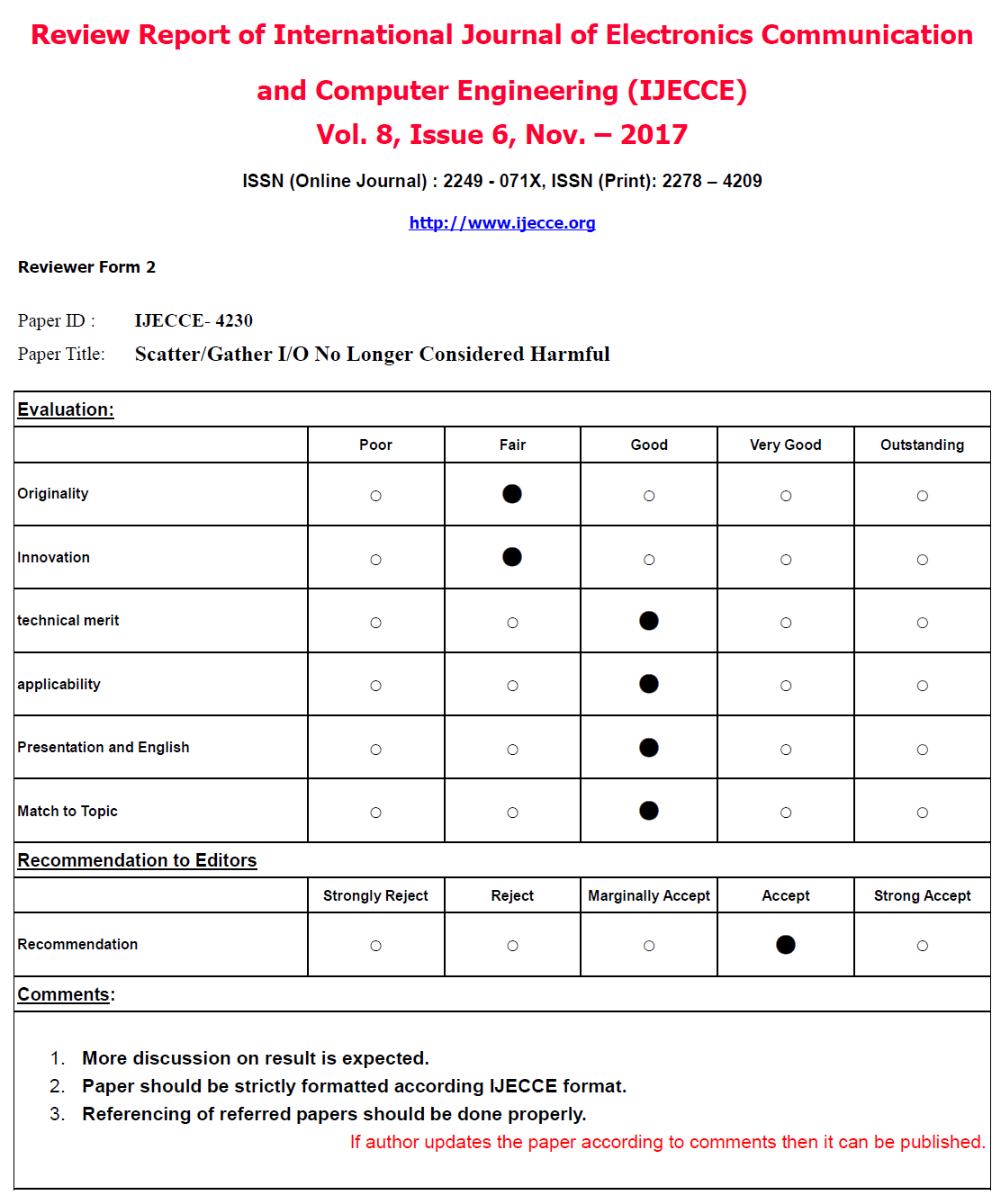
The very next day, I got an email with seven attachments! The paper had been reviewed and the referees' comments were in. Fantasic! I was looking forward to read about how the paper was utter nonsense and could not possibly be published. It was going to be a great rejection letter, I was sure. Imagine my surpise when I read this:


And, 40 minutes later, this:


The same paper accepted in two different journals! This was despite their insistance that no paper can be considered for publication if it is being considered for publication elsewhere. They had messed that up, big-time. Still, I was looking forward to the referee reports. Given that the paper was pure random mush, they must have pretty steep requirements? Here are the referee reports, 1 and 2.


This was getting rather stupid. Both journals sent exactly the same referee reports. They were behaving like money-grubbing idiots, so I felt that this was the time to close this down. Here was my final message to both journals:

I am not paying money to publish a paper in your journal. You should have mentioned that there was a fee before you embarked on this process. By the way, I don’t know who you asked to review this paper, but they have no expertise in this area. They have utterly misjudged this paper. Your editor-in-chief is also ignorant in relation to the topic of your journal. I have no idea why you think I would pay money to publish in such a terrible journal. What are you playing at?

You do not even sign your emails with a name. This is not an academic process in any way. If you want to publish this paper in your so-called journal, go ahead. But I am not paying a penny. And I don’t care whether the paper cannot be withdrawn. Keep it. It can bring you nothing but disrepute.


They never answered this, and I suppose they never published the papers. Now the agriculture journal have written asking for another paper. I am not sure I can be bothered again. It took much longer to write this blog post than I spent on the actual tasks. But then, that's the price of having a blog!


Thursday, 26 October 2017

Bringing science into disrepute

There is a growing number of journals and conferences whose sole purpose seems to be to elicit papers and then charge authors for publication. This is not the route to scientific communication and dialogue. Here is today's example, which seems to be sent to anyone they can get an email address for, regardless of the kind of science or quality of work:

Journal of Applied Science and Innovations

Dear Dr Professor Will Hughes

Greetings from Journal of Journal of Applied Science and Innovations 

To celebrate the Vol. 1 Issue 3, it is our pleasure to invite you to contribute an article. Your contribution will help the journal to establish its high standards and get indexed by prestigious indexing services soon.

Short-communications, Review articles, Research articles, Case reports etc. are also accepted.

Note: On this happy occasion, we are here to announce that those who contribute their manuscripts will receive Discount to the articles submitted on or before November 10, 2017.

Submit your article at to this E-mail id.
appliedscience@rroij.com, editor.jasi@peerreviewedjournals.com

Please provide your acceptance to the same.

Look forward for your reply

Best regards,
Cynthia Grace
Journal Coordinator 
Journal of Applied Science and Innovations

Disclaimer
This message is confidential. It may also be privileged or otherwise protected by work product immunity or other legal rules. This email and any files transmitted with it are confidential and intended solely for the use of the individual or entity to which they are addressed. If you have received it by mistake, please let us know by e-mail reply and delete it from your system; you may not copy this message or disclose its contents to anyone. The views, opinions, conclusions and other information’s expressed in this electronic mail are not given or endorsed by the company unless otherwise indicated by an authorized representative independent of this message.

There are hallmarks of fake standing here. Claims that the journal has high standards and hints that it might become indexed by as commercial indexing service, as if that were a badge of recognition. It isn't. Many indexing services are indiscriminate. The list of types of communication that indicates they will take anything as long as you pay. You can even get a discount on the charges for publication if you are quick! So, the only things missing from this is any connection to a recognised University, an established publisher, an international editorial board, a web page, even a named editor who is an authority in a particular field.

I sincerely hope that no one is taken in by this cynical practice of milking the academic community for money.

Sunday, 20 August 2017

Chale Wote Arts Festival 2017

Avoid Chale Wote festival, Jamestown, Accra. It is dangerous. As soon as I walked near to it, six burly men wearing white tee-shirts with the word "Security" in white letters on black background accosted me. They were rude and aggressive. They had seen me taking a photo of some graffiti as we strolled down the street. We had seen no entrance, and no apparent barrier into this festival. I was not even planning on spending more than ten minutes on this festival, as I wanted to visit other places in the vicinity. These men surrounded me, held my arms and roughly manhandled my expensive camera from me. They were all shouting very threateningly that I was not allowed to take photos without a permit and I would need to pay GH$250. “This is not America”, they shouted as the marched away with my camera signalling that I should follow. I tried to explain that I was not American, but they were not interested. I supposed that they were not referring to nationality but to the rule of law and human rights. I shuddered inside. This was scary. Should I go with them, or just write off the camera and all the photos from the trip so far?

The further we walked, the more shocked and scared I became. I had already been walking around Jamestown, having first visited the Fisherman's Village. The plan was to swing through this festival (AKA giant art sale) and visit the boxing gym to see and photograph the local kids being trained. But these security thugs were not interested. They walked away with my camera and someone said, “go with them”. I had no choice. They marched me to the quadrangle of some old building and they took my camera indoors and upstairs while I was told to wait outside in a quadrangle, surrounded by a crowd of about 20 beefy men with bulging muscles and tight shirts and scowling faces. These were thugs, not security people, despite what it said on some of the tee-shirts. My guide was also clearly disturbed by this and started calling his boss to come and help, and the other guide duly turned up. Lots of shouting in local language. I was nervous and feeling extremely vulnerable. Even the guides were ineffectual at getting my camera back or calming the thugs.

After ten minutes, the first man, tall and threatening with his moustache and posturing body language, came back out and barked questions at me but did not let me answer. He said I must go with him to pay this money and get a permit. After several attempts at asking him to just listen quietly, I managed to tell him who I was, that I was not a commercial photographer, and that I was not interested in permits or commercial arrangements. I just wanted my camera back and to leave, as I was running short of time by now. I was on a three-hour window to explore this area and I didn't want to spend any more time in Chale Wote Festival. I told him my name and workplace and showed him my business card. He made a token attempt to look up my name on the internet but just shouted the strange response, "your name is not in the database, I don't trust you, you are collecting data and you cannot have data for free, you need to pay". He then walked across to a quieter part of the quadrangle and told me to go with him away from the thugs. he looked me in the eye and quietly asked, "OK, do you work for MI5?", "no sir", I answered politely. "Do you work for MI6?", "No, sir", I answered politely. A short pause then he said, "OK, I don’t believe you. You are being tricky, you are a spy". What demented fantasist! Clearly, whatever I had to say was of no interest or significance. The man was a delusional mobster and imagined that he was a really important part of the festival, because he could command some thugs to be violent. So I was as meek and calm as I could be.

I was then marched over to another place. On the way, we walked passed the graffiti that I had photographed in the first moments of this terrible experience. Two small boys, about 11-12 years old attracted my attention. One took my hand momentarily while we walked and said quietly and calmly, “don’t worry, you will get your camera back”. He smiled while he said it and for some reason, this was remarkably reassuring. His friend on the sidewalk pointed at the people with my camera, then at himself that and me and mimed, “you will get it back”. My emotional reaction in this turmoil turned to amusement as I digested the irony of what the boys was indicating – that if the thugs did not give it to me, the boys would just steal it and bring it to me! Amazing. I would have happily paid them if it came to that. (Afterwards, I discovered that they had already ascertained which taxi was waiting for me, so they would know where I was later, if it came to that. Fighting fire with fire, I thought.)

In this next location, other people shouted at each other for a while, the original thugs having disappeared, apart from the one carrying my camera, although he had no security tee-shirt or anything that would identify him. I started to imagine that he was holding the camera until someone gave him some money. We then went to yet another place, something like a car park with gazebos and a place where permits on lanyards were being sold to people filling in forms and parting with cash. Various unknown and unidentifiable people yelled at each other and argued. My senior guide was getting so angry at these idiots he was shouting and waving his arms and it all seemed as though things might get violent, after all. And then finally someone calm faced me and said, "OK, you can have you camera back if you pay GH$250 for a two-day permit but you must ask your man to stop shouting so aggressively". I said that he was not “my man” and I did not want a permit; I did not want to take any photos; my time at this venue was finished. I just wanted to leave.

I had been held detained for nearly an hour by now and was getting very thirsty in the hot sun and was sick with worry. Three Police stood nearby looking completely disinterested; clearly, this was normal life. I tried to stand near them and to get their attention, but they were totally oblivious and uninterested. I guessed that they needed cash in order to intervene and only worked for the highest payer. I could not compete. Finally, a big man about 6 feet 6 inches tall joined in. He would not speak to me or make eye contact. When I tried to explain myself to him he just shushed me and said, "I want to know what these guys are telling me". He did not want to know what I had to say. Then another man joined in and he would not let me speak until he heard what the shouty people had to say. Finally, he looked at me and said calmly that they had a big festival, that he was the representative of the mayor and some other authority, that they were providing blanket coverage of the whole event to ensure that nothing untoward happened, that they were conscious of the need to control and manage what was going on and that I would get my camera back. He asked me for my account of the situation and I explained that I was a professor here for a conference that was over and had just taken a short walking tour of Jamestown with a guide in order to take some photos and see local life. I was not really interested in Chale Wote. It was just something we came across. “There has been a misunderstanding”, he said. “Fine”, said I, “can I please have my camera back now as I need to leave”. “You will get your camera back”, he said, and then took me with an entourage of more shouty people, including the youth who would not give up the camera, to another place with big steel doors and a little step-through gate, into yet another courtyard. Here, there were some artists demonstrating their art of making something to an audience. For some reason, we had to stand here to argue some more with the same people. It was getting surreal. I tried to ask this senior man, if I was going to get my camera back, could we stop arguing about it and just give it back to me so that I could be on my way. But, apparently, he still had to argue with a few more thugs first.

Finally, in this performance space, the youth relinquished the camera, and I was allowed to put it back in its case, which was still on my shoulder. I left with my guide because the car I had booked for the morning was waiting for me, and there was now only sufficient time to back to the hotel before the agreed car hire time elapsed. I was called back, of course, as these people, whoever they were had not finished. Now, the issue was that they did not want me to leave feeling victimised, bullied and upset. The mayor's rep wanted to apologise and wanted me to accept that it was just a little misunderstanding. Despite my inner anger and extreme anxiety about spending another moment in this terrible place, I shook his hand, looked him in the eye, and quietly, calmly thanked him for his apology and told him I accepted it. Then I walked away at a brisk pace without looking back, as they continued to shout their vain attempts to persuade me that this was just a little misunderstanding. Finally, back at the car the guides wanted money even though they had failed to provide the protection that they had promised and they would not let the car go until I handed over something. They said they had helped me because they had got my camera back. I said, no, you made it worse by shouting and jumping around as if you were going to beat someone up. I had got the camera back myself from the mayor’s representative by talking quietly and calmly. But they insisted that I had to donate something to the free school they ran for the fishing village kids, so I had to give them some money in order to leave. Actually, the taxi driver gave them some money, because he wanted to leave. I refunded him later. By now, I just needed to get out of there as quickly as possible without looking back.

After struggling through road blocks and police and security people shouting that we were not permitted to drive out, as we should never have driven in, we finally escaped. What a bloody shambles. As you might imagine, my recommendation is steer clear of this place unless you leave your camera at home. Even then, steer clear of Chale Wote Festival. It is an awful, nasty and brutish place where gangs are operating under cover of some kind of fake authority. If you must go, stay in a large group with some strong, local, official guides with you at all times. And don’t take a camera!

Tuesday, 15 December 2015

Units of measurement

As a society, we have, for centuries, been developing measurement standards and a variety of units for a wide range of purposes. But watching and listening to BBC, I have come to realise that there is now only one unit of measurement; football pitches. Everything on the BBC is measured in football pitches. So, what I want to know is, how big is a football pitch? I wish we could use real units of measurement.

Tuesday, 21 July 2015

Conceptualizing a research project

In my work as a supervisor of dissertations, whether BSc, MSc or PhD, I have developed an approach to help with research design and developing an outline of research.

The first question that needs to be settled is, what kind of science does the student want to do? Incidentally, social science is a kind of science in my mind. Who are the key researchers in the field that this students wants to base his/her work on? Some kind of conceptual model is usually required to make clear how the main concepts connect. The main concepts would be drawn from the research literature on the topic.

Second, where is the data from and how will it be analysed? Many students begin the dissertation process with a description of the kind of observations they wish to make, but this can only be part of the research design if it is placed in the context of the conceptual model, which itself is based on a theoretical position.

Third, if someone is working in a well-trodden academic discipline with a clear theoretical tradition that underpins it, then they typically do not explain their theoretical position, since understanding that is taken as a basic tenet in the discipline. So it is fair to expect that many papers will be silent about their theoretical perspective, even though it can be implied from the kind of question they are dealing with. In a multi-disciplinary or inter-disciplinary field like construction management, it is important to be explicit about the theoretical position. This does not always need a whole chapter. It is sometimes a few lines in the early part of the dissertation.

Following these three aspects, the initial work will rely heavily on literature review and will set up theory-concept-observation as an axis that leads to the research design. I tend to insist on a clear explanation of the connection between theory-concept-observations. Every dissertation student, I think, needs this to be clear in the write-up. This initial setting up will eventually form approximately half of the thesis followed, of course, by the second half; analysis-discussion-conclusions, which acts as a kind of mirror to the first half. These may be translated approximately into chapters: introduction, literature, methods. And it is useful to think how the analysis reflects the methods; the discussion reflects the literature (and conceptual model); the conclusions reflect the introduction.

With this conceptual model of a research dissertation in mind, I find supervision becomes much more transparent and students tend to see better where they are headed. There is no strict recipe for a dissertation, of course, and each student will change this initial framework as their confidence grows. But I find it forms a good starting point. Many different kinds of research can be covered by adapting this model to fit the kind of research.

I sketch this out frequently when talking to students, annotating it with keywords and ideas that relate to their specific interests and type of research. Sometimes it needs significant changes in order to make sense. But it still forms a good starting point for the early discussions when the student does not really understand what it means to do research and the supervisor does not really understand what the student wants to do. I have not yet had time to prepare a nice graphic with drafting software, but a pen-sketch is good enough:

The diagram shows how the conclusions relate back to the theory, how the discussion chapter relates to the conceptual model and how the analysis relates to the observation. It also shows how the aims inform the theory, the theory informs the objectives, the objectives drive the literature review to provide the conceptual model, the conceptual model leads to the research design and so on. Finally, we can see how the general issues lead to increasingly specific issues in the first half, and the second half involves moving back to generalized statements for the conclusions.

It must also be noted that not all research goes through this sequence. Ethnographic methods are often highly appropriate for construction management research, especially for those who have experience in practice. It is not always necessary to behave as if you have no experience or as if you were an outsider to the industry. If you are an insider, then look at ethnographic methods. These often involve immersing oneself in the field and then developing theory from the experience. For part-time MSc students, in particular, this is a very powerful way of construction a piece of valid research.

Wednesday, 23 July 2014

Why vegetarian?

People often ask me why I am vegetarian. They seem to find it odd. So many people seem to find it difficult to contemplate excluding meat from their diet. Watching this video reminded me that I find it it difficult to understand why anyone would willingly eat meat or fish. Not only the mindless slaughter; not only the unnecessary damage to the environment. But why would anyone choose to put this stuff into their mouths? Indeed, why would anyone put this into their children's mouths? I suppose that people can continue to eat meat and feed it to their children for as long as they avoid finding out anything about the processes that bring it to the supermarket. And I know many people who claim to be in the 1% who buy meat that is not factory-farmed. But, what about this: "As people become more aware of the horrors of factory farming, companies are responding by labelling their products “all-natural,” “free-range,” “free-roaming,” or “organic.” But these labels are misleading. Most “free-range” animals are still mutilated and forced to endure long trips to slaughterhouses without any food or water. Moreover, they all have their lives violently cut short and are denied the opportunity to engage in anything that is natural and important to them." Read more here.

Well, have a look at the video, eat some chicken and then reflect on whether there are viable alternatives to eating meat...

Tuesday, 12 June 2012

Doctoral researchers working with industry

There are at least two perspectives for doctoral researchers contemplating working with industry. First is the problem of negotiating access for data collection and second is developing networks of industry contacts for the purposes of further career development. Many researchers feel that practitioners may be nervous about disclosing commercially sensitive or personal information. It is useful to understand such nervousness and deal with it. This requires clarity and honesty about why data is needed, and a careful data collection strategy that avoids giving the impression that data is being trawled on the chance that something useful will emerge. Some participants seem responsive, others don’t. Therefore, do not worry about unresponsive individuals but focus on finding the responsive ones. Many companies fear that they may give away time that they cannot afford, or, worse, reveal confidential information that might weaken their competitive advantage. It helps take an approach where they stand to gain from participation. It also helps if we talk like someone who understands and appreciates the nature of commercial confidentiality (like you mean it). Generally speaking, companies may not be interested in the intellectual aspects of research but they will be interested in problem-solving. So, try to think about what you might give them in return for their participation that helps with problem-solving. It will probably not be the same material that you incorporate into your thesis, but that’s usually a good thing. In terms of networking, it helps your data collection and negotiation of access if you are not a complete stranger. There are strategies for developing networks, inviting industry people to seminars on campus about your research (involving your supervisors and other academic staff as well as alumni of your School or Department), setting up discussions on serious social networks like LinkedIn and so on. Some time ago, a researcher in USA, Phil Agre, wrote about using the internet for developing research and professional networks and he updates it from time to time. It is worth looking at: http://vlsicad.ucsd.edu/Research/Advice/network.html

Search This Blog

Blog Archive

About Me

My photo
Reading, Berkshire, United Kingdom

Total Pageviews